
Your engineers are expensive.
Find out if you're getting your money's worth. Most engineering teams lose 40–60% of engineering time to reviews, approvals and coordination. We find exactly where work gets stuck — and what fixing it is worth.
Find out if you're getting your money's worth. Most engineering teams lose 40–60% of engineering time to reviews, approvals and coordination. We find exactly where work gets stuck — and what fixing it is worth.
Run by CTOs who run engineering teams.
Not consultants. CTOs responsible for real engineering budgets. They've seen your problem before — and fixed it last week in someone else's team.
Your engineers keep shipping.
No interviews. No surveys. No meetings with engineers. We analyze what they do, not what they say — without touching a single sprint.
Every finding has a price tag.
Every finding comes with the estimated cost of doing nothing. Fix this first. Save this much. You walk away with a decision — not another dashboard.
Findings fast enough to act on this quarter.
No discovery phase. No retainer. No "let's align stakeholders." Fast enough that the decision lands before your next board meeting.
Request the audit
Get the process started in minutes.
Analyze workflow data
Commits, pull requests and review events.
Detect bottlenecks
Review queues, approval delays and idle time.
Build the audit report
Every finding ranked by business impact.
Leadership briefing
What to fix first and what it's worth.
Fast-moving teams already ship more with AI-assisted development. If your delivery was slow before, the gap keeps growing every quarter. The audit shows what is holding you back before it becomes a bigger problem.
Engineering payroll is your largest fixed cost. Most leaders can't explain what they're getting for it. We can.
The hours between "PR open" and "merged" — who's paying for that?
A PR sitting unreviewed for 3 days isn't a people problem. It's a system problem with a dollar amount attached. We show where the wait happens and what it costs per sprint.
Your most expensive engineers are waiting, not shipping.
Senior engineers blocked on approvals are your highest hourly cost sitting idle. We measure exactly what that blocked time costs per release cycle.
Two engineers carry 80% of output. Do the math on the rest.
When output concentrates in a few people, the rest of the payroll isn't earning its return. We surface the imbalance — so you can fix the system, not blame the people.
You don't know what one feature actually costs you to ship.
From first commit to production, we calculate the real number. Most teams are surprised. The problem is rarely where they expected.
Most teams are surprised. The problem is rarely where they expected.
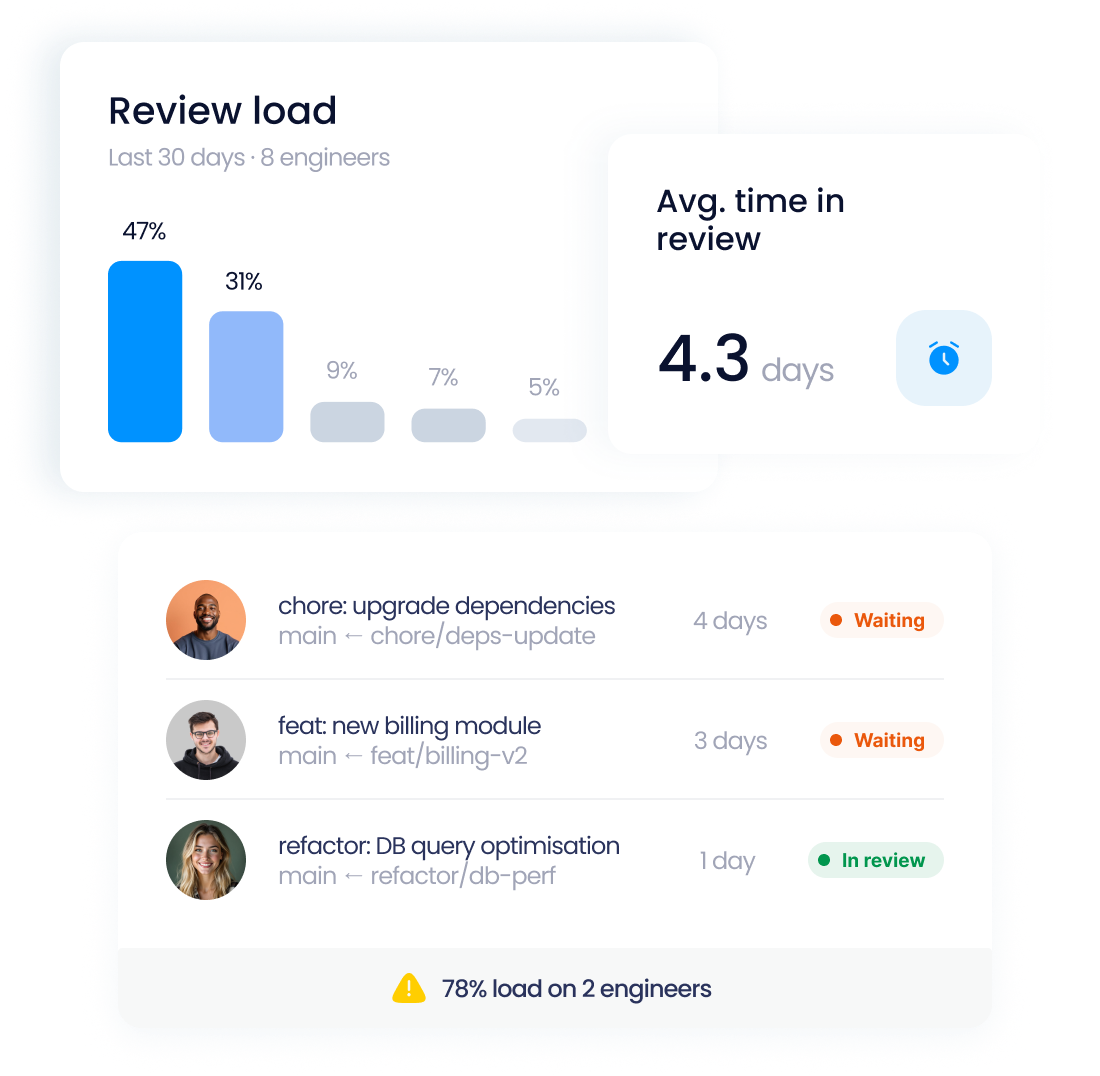
PRs waiting days for review
Code sits approved in all but status. Every day it waits is engineering payroll burning for nothing.
Senior engineers blocked on approvals
Your highest hourly cost sitting idle, waiting for a sign-off that takes thirty seconds.
Review load concentrated in two or three people
One reviewer out sick and the whole team stalls. A system risk hiding as a people problem.
Hidden delays between commits and production
Time disappears between "done" and "deployed." We find where — and put a cost on it.
Both reveal where engineering time and money are leaking. The difference is how deep we go.
Workflow Audit
Git workflow data only
Identify what to fix first. See where engineering time is being wasted and what it is costing you.
Workflow + Code Analysis
Includes code change analysis
Everything in the Workflow audit, plus deeper analysis of code changes and architectural risks.
FAQ
What do we actually get at the end?
A structured written report with findings ranked by business impact — not just technical observations. You'll see which bottlenecks cost the most, what a realistic fix looks like, and what to prioritize first. The Deep Dive also includes a live walkthrough session with your engineering leadership team.
How long does the audit take?
The Standard audit completes in days from the moment access is granted. The Deep Dive includes an additional leadership briefing session. Both options include full written findings.
What kind of return can we expect from fixing the issues you find?
Across teams we've audited: 2–4x reduction in PR cycle time, measurable drop in blocked senior engineer hours, faster releases without adding headcount. We also tell you where hiring more won't help — which saves more than the audit costs.
How is this different from hiring a consultant?
Traditional consultants bill by the month and rely on interviews and gut feel. We analyze actual behavioral data — what the team did, when, and how — so findings are grounded in evidence, not impressions. You get results in days, not months, and the analysis doesn't disrupt your team's daily work at all.
What data do you actually access?
We analyze Git workflow data — commits, pull requests and review activity — from your GitHub or GitLab account. File contents and business logic are never accessed. Access is read-only, granted for the audit period, and can be revoked at any time.
Do you analyze our source code?
It depends on the tier. The Workflow Audit analyzes Git workflow data only — commits, pull requests and review activity. File contents are never accessed. The Workflow + Code Analysis tier does analyze source code to assess code change complexity and architectural patterns. Either way, access is read-only, granted for the audit period only, and can be revoked at any time.
No long setup. Zero access to your codebase. You get a prioritised list of exactly where your engineering budget is leaking — and a clear plan for what to fix first.

